

 By
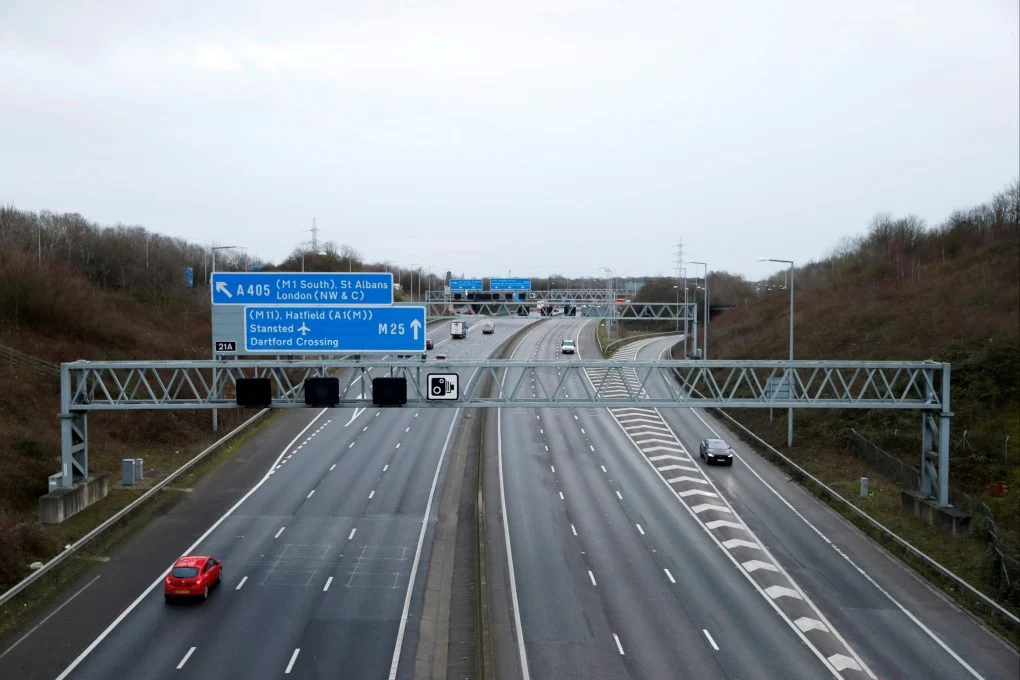
By As of Spring 2026, the UK has transitioned from theoretical debate to the practical application of autonomous travel. The M25, London’s notoriously congested orbital motorway, has officially become the primary laboratory for this experiment. Following the full secondary legislation of the Automated Vehicles Act, National Highways has designated specific “Autonomous Zones” along the motorway’s most demanding sections, marking the first time in British history that “hands-off” driving is not only legal but structurally encouraged.
To Know More:- Boston Startup Ecosystem in 2026
The Orbital Laboratory
Selecting the M25 for the UK’s first autonomous pilot was a deliberate stress-test. With its unique mix of heavy freight, intense commuter surges, and complex multi-lane junctions, the motorway provides a level of data density that simpler rural roads cannot match.
- Dedicated AV Lanes: The pilot has introduced specialized “Smart Strips”—lanes equipped with high-fidelity sensors and enhanced digital lane markings. These lanes are exclusively for vehicles authorized under the 2024 Act, allowing them to travel with reduced following distances, which effectively increases the motorway’s capacity by up to 15% during peak hours.
- The “User-in-Charge” Era: Under the new legal framework, drivers in these lanes are classified as “Users-in-Charge.” This allows for “eyes-off” travel, where the occupant can engage in secondary tasks while the vehicle’s Authorised Self-Driving Entity (ASDE) takes full legal responsibility for the journey.
- Intelligent Junction Management: At major intersections like Junction 15 (M4) and Junction 21 (M1), the road infrastructure now communicates directly with the vehicles. This V2I (Vehicle-to-Infrastructure) link ensures that merging traffic is synchronized perfectly, eliminating the “phantom braking” that traditionally causes London’s infamous orbital tailbacks.
The Freight Platoon Pilot
While passenger cars are the most visible part of the trial, the real transformation is occurring in the logistics sector. The 2026 M25 trials have become a showcase for autonomous heavy-goods vehicle (HGV) platooning.
- Digital Tethering: Large freight fleets are now operating in “tethered” convoys of three to five trucks. Only the lead vehicle requires a human monitor, while the following units mirror its movements with millisecond precision. This has led to a significant reduction in fuel consumption and a smoother flow for all other motorway users.
- Overnight Logistics: To further ease congestion, the London Logistics Plan 2026 encourages these autonomous platoons to operate during the “off-peak” hours between midnight and 5:00 AM. This quiet, robotic transit of goods ensures that the capital’s shelves are stocked without adding to the daytime gridlock.
- Safety Sovereignty: By removing the factor of driver fatigue—a leading cause of accidents on the M25—the autonomous lanes have seen a measurable drop in minor collisions. The AI systems are programmed with a “Safety-First” mandate, maintaining a level of vigilance that far exceeds a human operator during a grueling two-hour commute.
The Infrastructure of Tomorrow
The success of the M25 trials in 2026 is built on a massive, invisible digital architecture that spans the entire 117-mile loop.
- Holographic Signage: New overhead gantries no longer just display static text; they use directional light to project “Virtual Gateways” that only the sensors in self-driving vehicles can interpret, providing real-time instructions on lane changes and speed adjustments.
- Edge Computing Hubs: Every two miles along the M25, localized data hubs process the massive streams of information generated by the autonomous fleets. This ensures that the system reacts to a hazard in the Dartford Crossing before the ripple effect can reach the Heathrow junctions.
- Real-Time Legal Shifting: The 2026 system is capable of “Dynamic Authorisation.” If weather conditions or roadworks make a section of the M25 unsafe for autonomous mode, the infrastructure sends an immediate “Transition Demand” to the vehicles, signaling the “User-in-Charge” to resume manual control within a safe 15-second window.
Why the UK Leads in Autonomy
The M25 project has positioned the UK as a global leader in the regulatory and physical deployment of self-driving technology.
- The Safety Standard: The UK’s “Statement of Safety Principles” requires that every vehicle in the M25 lanes be at least as safe as a “competent and careful” human driver. This high bar has fostered public trust and ensured that the transition to robotic roads is viewed as a safety upgrade rather than a risk.
- Economic Connectivity: By streamlining the M25, the UK is effectively “shrinking” the distance between its major international gateways. A faster, more predictable orbital route means lower costs for businesses and more time returned to the millions of people who navigate the London region every day.
- The Blueprint for RIS3: These trials are the cornerstone of the Road Investment Strategy 3 (2025-2030). Lessons learned on the M25 are already being used to design the next generation of “Digital Roads” across the entire UK Strategic Road Network, promising a future where the traffic jam becomes a relic of the past.
To Know More:- The boom of high-capacity electric pickups in rural America